







Throughout my career in education, I have served in many roles—one-to-one aide, teaching assistant, curriculum leader, special education liaison, and classroom teacher just to name a few. One thing has remained constant: helping students grow as writers. No matter the grade level, writing is an important skill that supports learning, communication, self-expression, and critical thinking. As educators, we have the opportunity to nurture these skills early on, helping our young writers build confidence and develop a strong foundation for future success.
Teaching the writing process in 2nd grade
Second grade is an exciting year for writing instruction. At this stage, students are building on foundational skills they developed in kindergarten and first grade while becoming more independent writers. It’s the perfect opportunity to reinforce key writing skills, deepen students’ understanding of the writing process, and introduce new strategies that support their growth. At the same time, many second graders are still learning how to effectively organize and communicate their ideas in writing. Therefore, teaching students to write requires using a variety of instructional methods and strategies to effectively guide students through each stage of the writing process.
Types of writing for second graders
I always like to think about teachers having a toolbox. Inside our toolbox, we put the strategies we have acquired through our own learning and experiences. When our students need a particular tool, we can pull the appropriate resource, activity, or strategy to help guide our students in their learning. Teaching writing to elementary students calls for a range of tools as they are learning how to write in different ways and even in different styles.
In second grade, students concentrate on opinion pieces, informative/explanatory texts, and narratives. Each text type requires specific guidance and support from educators and even peers.
Opinion writing
Opinion writing is often a favorite in second grade because students naturally have ideas and preferences they are eager to share. This type of writing encourages students to state an opinion on a topic and support it with reasons and examples. Opinion writing can provide meaningful opportunities to strengthen writing and critical thinking skills, as students develop the ability to justify their thinking. Some examples of opinion writing prompts include:
- What is the best ice cream flavor? Why?
- Do you think board games are more fun than computer games? Explain why.
- Which season is the best? Give reasons to support your opinion.
Informative/explanatory writing
Informative/explanatory writing gives second graders the opportunity to explore a topic and share they they learned with others. In this genre, students use facts, details, and definitions to explain a topic clearly and accurately. Rather than sharing an opinion or telling a story, informative writing focuses on teaching the reader about a subject. Some examples of informative/explanatory writing prompts are:
- Explain the lifecycle of a butterfly.
- Write about football and share facts about how the game is played.
- Describe how frogs and toads are alike and different.
Narrative writing
Narrative writing allows second graders to become storytellers as they write about real or imagined experiences. Whether they are retelling a memorable event or creating a fictional adventure, students are often excited to bring their stories to life on paper. Through narrative writing, students learn to sequence events and develop a story with a beginning, middle, and end. Because students can draw from both their lived experiences and their imaginations, narrative writing can be a highly engaging genre for young writers. Some examples of narrative writing prompts are:
- Describe the day you lost your first tooth.
- Tell the story about your favorite birthday ever and why it was so special.
- Write about a day spent exploring outer space.
How to teach each type of writing: 2nd grade writing strategies
In second grade, the teaching process is rather similar regardless of writing style. For example, writing instruction requires whole-class modeling, small-group coaching, peer review, and independent writing time.
At the very start of the year, before you introduce any writing unit, review the basics, like sentence structure and expected sight words. This way you can gauge where your students are, so you know what to focus on in small groups. A fun way to do this is by encouraging students to write about themselves. You might ask, “What do you want to be when you are older?” Then have them write a few sentences about it. This sort of activity helps me start making flexible groups as we work through the writing curriculum.
I like to open each writing unit with a mentor text that serves as an example of the genre of writing we will be focusing on for the weeks to come. Whether using picture books, whole books, articles, or excerpts as mentor texts, students can gain a lot of insight through scaffolded questioning. The text essentially models the specific type of writing we are working towards. Read-alouds are crucial in helping students uncover the possibilities they can strive for in their own writing. Impactful mentor texts also promote vocabulary development, exemplify story schema, and increase literary comprehension.
Then, it’s time to jump into the writing process! One of my favorite teaching tools is the anchor chart which provides visual reminders that can help students to be successful when working independently. Students are likely to remember the chart outlining the task because we created it together as a class; they can revisit it to spark ideas and continue their writing.
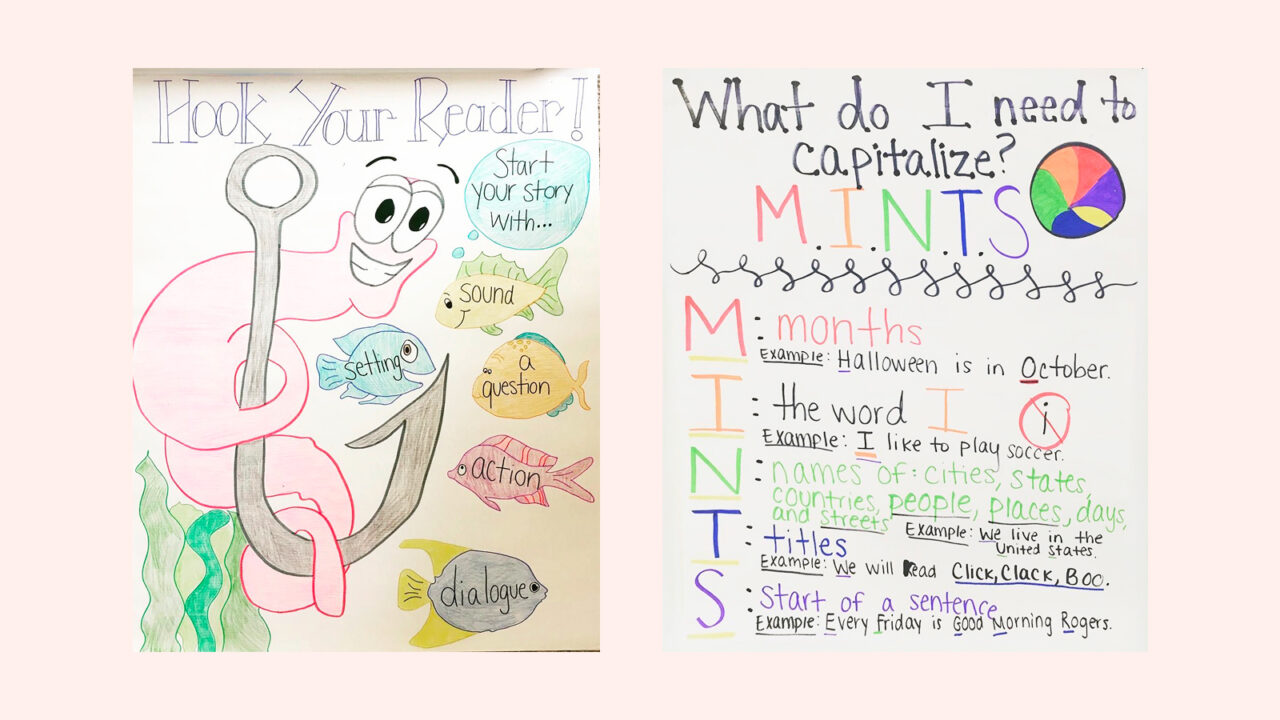
Writing anchor charts we’ve created and displayed in my class.
Traditionally, there are five stages: prewriting/brainstorming, drafting, revising, editing, and publishing. It is imperative for teachers to effectively model each writing strategy for elementary students along the way. This shows students exactly what is expected of them. Modeling is a tremendous tool in our toolboxes to teach writing throughout the unit, irrespective of grade level.
Prewriting/brainstorming
One of my tried-and-true brainstorming strategies is what I call the “sticky note method.” It’s a tangible way for students to gather and organize their thoughts either on a graphic organizer or in their writer’s notebook. I like to tell my class that even though the paper is sticky, they do not get stuck. Ideas, words, and sentences can be added or removed. Students can literally break up their ideas and move them elsewhere.
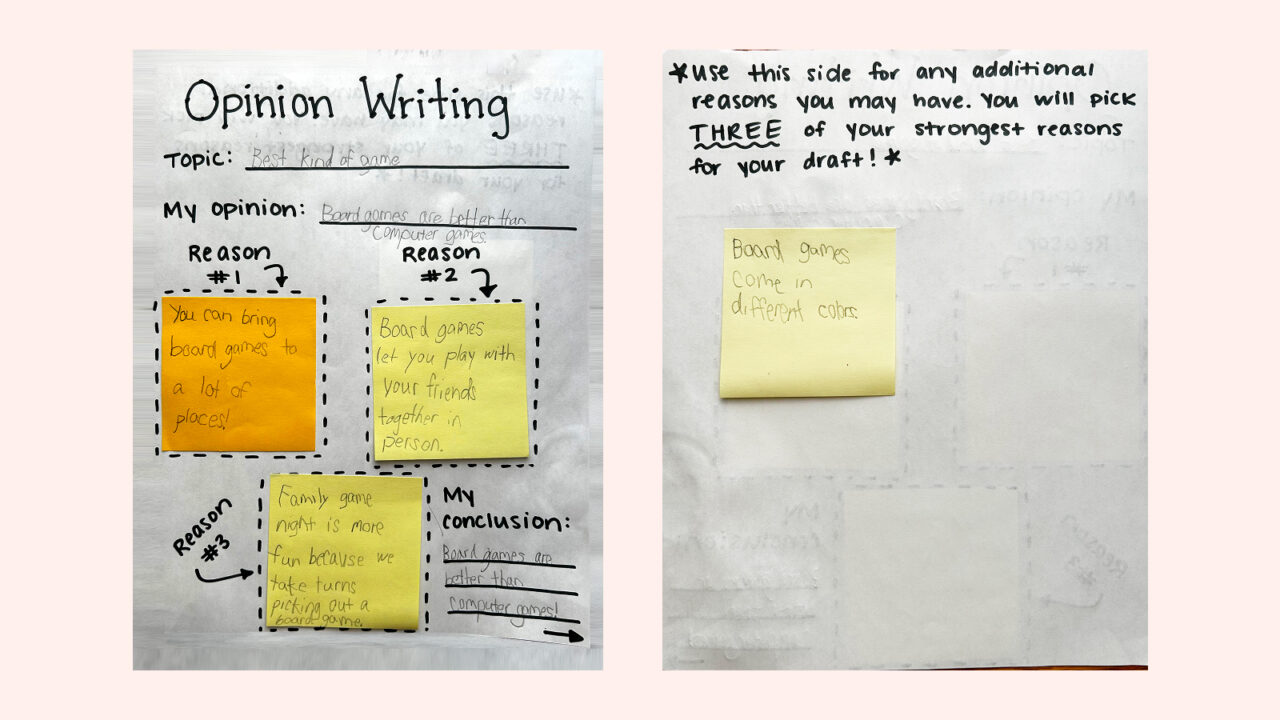
An example of how students use the "sticky note method" to brainstorm.
While similar in some ways, the graphic organizer will tend to be different in format or in language based on the writing genre.
- Opinion writing: I recommend “OREO” graphic organizers: Opinion, Reason, Example, Opinion. You could even use an “OREREO” organizer (adding an additional reason and example).
- Informative/explanatory writing: The sandwich organizer—topic sentence, fact #1, fact #2, fact #3, concluding sentence—is my go-to.
- Narrative writing: Completing a story map or a plot diagram is key for this genre because they include all the elements of a story.
Drafting
Providing students with sentence starters is a wonderful way to encourage independence in writing and differentiate instruction. For all writing units, I outline specific sentence starters with students. Sentence starters allow students of all writing abilities to organize their thoughts while still having ownership over their words because they are picking which ones to include in their drafts. Not all students may need sentence starters, and some may need more, so adjust accordingly. Of course, sentence starters do not need to be the only types of sentences in their drafts, but they do help students understand what is being asked of them to write about!
Revising
During this part of the writing process, I first teach students the ARMS acronym:
- Add sentences and words.
- Remove unnecessary words and sentences.
- Move sentences and words around.
- Substitute words or sentences with new ones.
Next, students read their drafts aloud to themselves as they work through the ARMS steps. Reading their own work aloud helps them better proofread. Lastly, I work with the students in a one-on-one conference to repeat each stage.
Editing
A helpful tool to guide students in their editing is the acronym CUPS*.
- Capitals: Check for capitalization at the beginning of sentences, I, names, months, places and titles.
- Understanding: Does it make sense?
- Punctuation: Check for periods at the ends of sentences.
- Spelling: Write the sounds you hear and spell known words and what is on the word wall correctly.
*Depending on the area of need for students, this acronym can also be CUPSS. The extra “s” is for spaces; leave appropriate space between every word.
To add some excitement to the editing phase of writing, I like to have students work together in pairs. I set up editing days like a game of “I Spy.” I provide a checklist for them to work through as they are reading their partner’s work. This sends them looking for things like “Find every name. Is it capitalized?” or “Is there punctuation at the end of each sentence?”
Publishing
Entering the publishing stage is a big accomplishment for second graders! They have just spent weeks drafting and now they’re ready for publication. There are so many ways for students to publish and share their writing. For example, students can publish their writing in their neatest handwriting or publish digitally. Using digital editing tools, adding images, and formatting their piece makes writing fun and students’ finished product special.
After students publish their work, it’s time to celebrate! I suggest planning a writing celebration where you give students the opportunity to share their finished writing with classmates or another class, or maybe even invite families and caregivers to the classroom.
Support for striving writers
The writing workshop model is a huge support for all students, especially striving writers. Following a mini lesson to kick off the period of writing, students are now actively working on their pieces. This is the time for teachers to work in small groups or one-on-one with students for additional instruction. This gives teachers a window into each student’s abilities so they can home in any areas of need. I might provide a student who needs additional help with spelling their own personal word wall, or I may modify graphic organizers to further narrow down key details. For example, if I’m working with a student who I notice is consistently misspelling the word “school” in their writing, I will help them add “school” to their personal word wall that they keep in their writing workshop folder. The goal is that they are reminded to reference it when they are using that word in their writing and eventually know it from memory.
Common challenges and solutions
It is important to get your students writing as much as possible. I set aside daily writing time, even when our schedule doesn’t allow for a full class period. This does not necessarily mean writing paragraphs each day, but there should be designated periods for students to put pencil to paper! Maybe it's five minutes of writing on the assignment we were working in the morning work or when the class comes back from recess.
Our classrooms are comprised of a range of learners. Your classroom likely has students who are striving, students who are performing on grade level, and students who are performing above grade level. What I love about the writing workshop model is that it allots time for whole-class instruction, then small groups, and even 1:1 conferences. This ensures all students are getting exactly what they need through the writing process and that may look different for each student depending on the style of writing.
Another helpful support for second grade writers is the use of simple, student-friendly rubrics. One common challenge for young writers is simply not knowing where to start. Introducing a rubric for each writing genre gives students a clear understanding of expectations and provides helpful guidance as they begin writing. These rubrics should use language students can easily understand and apply while writing. For example, a narrative writing rubric might include statements such as, “I start my introduction with an exciting idea to hook readers,” or “I use details to help readers picture the story.” Teachers can encourage students to refer to these rubrics throughout the drafting and revising process rather than at the end of an assignment. When students regularly check their work against simple success criteria, they begin to take ownership of their writing and develop stronger self-monitoring skills. Rubrics also help build confidence because students can clearly see what they are doing well and identify manageable next steps for improvement.
Setting young writers up for success
Teaching writing in second grade doesn’t have to feel overwhelming. Remember to use the tools in your teacher toolbox and model each step of the writing process to help students build confidence and develop strong writing skills. When writing is broken into manageable steps, students are better prepared for success. Writing instruction can be fun and engaging when students have the right support and the opportunity to explore their creativity and share their ideas.
The views expressed in this article are those of the author and do not necessarily represent those of HMH.
…
Guide students in Grades 3–12 through the writing process with Writable. Students are given feedback in real time to guide their writing, while saving teachers time on instruction and grading.
We want to hear from you! For questions, comments, or feedback, please contact us at Shaped@hmhco.com or follow us on Instagram, LinkedIn, and YouTube.
Be the first to read the latest from Shaped.